The Ledger of Unfinished Business Four Decades of Gender Economics in Ghana
Jennifer A. Moffatt, Norvan Acquah-Hayford
4/1/20263 min read
Ghana has spent four decades writing rules about gender equality, but following them is the part that keeps struggling.
Ghana has a long history of ratifying international frameworks and protocols, but lags behind in their implementation. Since ratifying CEDAW in 1986, the country has signed virtually every international gender framework on offer: ILO conventions, the Maputo Protocol, the Beijing Platform, MDGs and the SDGs. In 2024, parliament passed the Affirmative Action (Gender Equity) Act 2024, a law mandating 30% female representation in public decision-making bodies by 2026, with full parity targeted by 2034. The Mahama-led administration is now pushing through the Legislative Instrument needed to give the Act real teeth.
What is more, on paper, Ghana has assembled a comprehensive gender policy framework, but in reality, there is a huge gap between these policies and their actual outcomes. This highlights structural implementation challenges that need further assessment with immediate execution. Understanding these gaps is crucial for assessing the real impact on gender equality and economic development.
What Ghana Has Built
Hold it, the legislative record deserves credit before it gets scrutinised. Over four decades, Ghana has ratified every major international gender framework: the ILO Equal Remuneration Convention (1968), CEDAW (1986), the Maputo Protocol (2007), the MDGs, and SDG Goal 5. The 2024 Affirmative Action Act (Act 1121) sets a binding 30% female representation floor for all public decision-making bodies by 2026, rising to full parity by 2034. Public institutions are now required to earmark budgets for gender programmes, not a trivial fiscal commitment.
Let's note that the revised National Gender Policy (2025–2034) covers six areas: women's empowerment and livelihoods, access to justice, leadership and governance, economic opportunity, transformation of gender norms, and protection of women in emergencies.
It's not vague. On paper, it is a serious reform agenda which must be taken seriously. What it is producing in practice is a different question.
Politics: The Numbers Are Not Moving Fast Enough
Political representation is the most precisely measurable indicator Ghana has. The numbers are uncomfortable. To begin with, in Ghana’s 8th Parliament (2021–2024), 40 women held seats out of 275, accounting for 14.5% of total seats in parliament. The 2024 elections saw a slight increase, by just one more seat (41), with 32 from the NDC and 9 from the NPP. What is alarming is that, over an entire electoral cycle and following the passage of a landmark Affirmative Action (Gender Equity) Act, female representation grew marginally from 14.5% to 14.9%, meaning female political representation remained essentially stagnant. This still falls significantly short of the 30% threshold mandated by Act 1121 for that year. Let's note that it is only slightly above the sub-Saharan African median and less than a quarter of Rwanda's representation. Rwanda's Chamber of Deputies is 63.8% female, thanks to constitutional quotas and targeted party recruitment. Ghana has the legal mandate, but Rwanda demonstrates actual results.
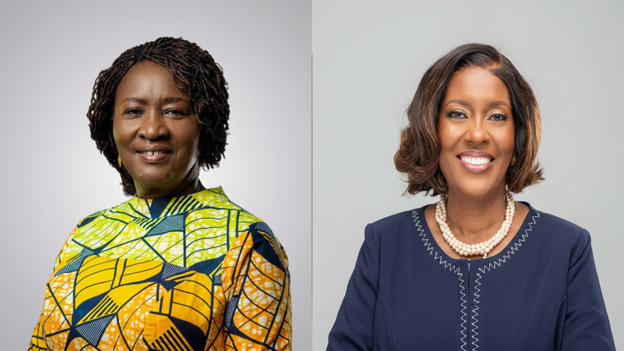
Images of H.E. Professor Jane Naana Opoku Agyemang - Ghana’s First Female Vice President and Mrs Efua Ghartey, Esq. GBA’s First Female President
Sub-national figures are even worse. Elected assembly members across district and municipal assemblies are 4.1% female. Unit committee members reach 12.8%. Appointed District Chief Executives land at 23%, better, but that reflects executive appointment, not electoral competition. There is a difference.
What is keeping women out? Primarily, unofficial information indicates that funding is a major barrier to women's access to politics, including party gatekeeping, racketeering, and the politics of insults. Campaigns are really expensive. Women have less access to party support networks and private capital. Act 1121 sets targets but stops short of imposing binding quotas on political parties themselves. So compliance is voluntary. Parties have not volunteered.
Ghana's first female Vice President and female president of the Bar Association are milestones that inspire pride and demonstrate progress to policymakers and citizens.
The Economy: Participation Without Protection
Also, Ghana's gender gap is not just a political problem; it is an economic one, and the costs are largely invisible in the national accounts. Women are 51% of the population. In 2024, female labour force participation was reported at 61.5%, against 64.6% for men, close enough on the surface. But 79.3% of employed women are in vulnerable roles: self-employment without contracts, benefits, or any legal protection. For men, that figure is 56.9%. This is the sector where women largely provide unpaid or underpaid care work that indirectly boosts the economy.
OUR ADDRESS
8, Whitestown Street, Parakuo Estate, Accra - Ghana
CONTACT US
+233 30 245 6209 +233 54 974 9237
WORKING HOURS
Monday - Friday
9:00am - 5:00pm
Powered by Odosgallery